Why do participants engage in endurance events, and how does this affect marketing communications?
Updated: Sep 2
This is a study I completed in 2020 using half-marathons, marathons, and ultra-marathons as an example. I have removed sections of this report for the purpose of online publication.
Research surrounding endurance event participation has been a growing topic since early research from Curtis and McTeer (1981) was published, outlining the motivation for running. Although such studies have recognised the growth of the customer-centric world (e.g., Fill, 2011, p. 5; Shank and Lyberger, 2015, p. 136), research has yet to investigate how participants affect marketing communications in endurance events.
This research paper aims to explore why participants engage in endurance events and how this affects marketing communications. It focuses on participants in 2020 using half-marathons, marathons, and ultra-marathons as an example, which will be referred to as ‘endurance events’ throughout this study. Throughout this paper, ‘marketing communications’ will reference the definition given by Fill and Turnbull (2016, p. 20) as “a process through which organisations and audiences attempt to engage with one another. Through an understanding of an audience’s preferred communications environments, participants seek to develop and present messages, before evaluating and responding”. This correlates to the term ‘engage,’ which will be used to refer to how an endurance event and participant are bridged together to achieve the goals set (Fill and Turnbull, 2016, p. 14).
The sports industry is a transforming sector due to the digital age; however, meeting the needs/wants of the customer remains a dominant feature of marketing communications within sporting events (Shilbury et al., 2014, p. 17; Doyle, 2000, p. 299; Chirila and Chirila, 2016). To properly understand customers’ needs/wants, this paper will look at the participant consumption behaviour model to explore why participants engage in endurance events.
Shank and Lyberger (2015) established this framework consisting of psychological, sociocultural, and situational elements that make up why a participant engages in an endurance event. To understand the study further, the term ‘participant’ will indicate someone who has taken part in an endurance event before or is signed up to take part in one. This will allow for a select group of people to be targeted and a more precise study to take place.
According to a report from Andersen (2020), endurance event participation has been increasing over the past decade. Yet, endurance events have limited media attention despite the wide variety of participants (Zhang et al., 2003, p. 96; Reuter, 2012, p. vii). This study has been conducted as a result of the researchers’ personal experience with endurance events that ultimately formed their interest in why participants continue to do endurance events and how the organising bodies have influenced this growing population’s decision.
A range of studies have shown why participants engage in endurance events; however, there has been no definitive evidence that the participant plays a significant role in marketing communications (e.g., Kang, 2014, p. 76; Seo and Green, 2008, pp. 105–106; Masters and Lambert, 1989). This research intends to advance the understanding of how to properly attract participants to endurance events.
This study seeks to address the following research objectives to broaden the scope of the research question.
To analyse participants’ consumption behaviour towards endurance events.
To analyse the development of marketing communications within endurance events.
To discuss how the participants’ consumption behaviour has influenced marketing communications.
Participant consumption behaviour
A key concept from this study is the reason why participants engage in endurance events. Whilst the definition of ‘engage’ that was given earlier creates a broad foundation for this matter, it is important to create recognition for the interrogative word ‘why’ used in this study. Utilising the work from Shank and Lyberger (2015, pp. 137–169), this section of the literature review adapts the model of participant consumption behaviour to explore why participants engage in endurance events.
Three categories make up the participant consumption behaviour model: psychological, sociocultural, and situational, for which an in-depth study surrounding these areas will be made.
Psychological
According to James (1890), ‘psychological’ can be defined as “such things as we call feelings, desires, cognition, reasoning, decisions, and the like“. A range of studies look at psychology within sport closely relating to motivation, as it creates an enhanced understanding of the environment to create more beneficial outcomes (e.g., Ng and Lonsdale, 2010, p. 209; Vallerand and Rousseau, 2001). For the purpose of this study, the definition of ‘motivation’ first suggested by Kotler and Armstrong (2017, p.174) will be used, who referred to it as “a need that is sufficiently pressing to direct the person to seek satisfaction”. This topic allows for analysis to be made on why participants engage in endurance events by creating a discussion on the literature surrounding motivational engagement.
Much of the literature prior to the 1990s generalised motivation within sports as illustrated through studies such as Maslow (1943) and Beard and Ragheb (1983). Maslow (1943) created a framework known as the ‘Human Needs Hierarchy’, which outlines the motivations of customers. In Beard and Ragheb’s (1983) study, they found that participants for leisure activities only had 4 motivators. These studies highlight the importance of sport within participants’ lives by showcasing that motivation features multiple characteristics (Shank and Lyberger, 2015, p. 146; McDonald et al, 2002). However, both fail to specifically identify what motivates people to engage with endurance events, therefore creating too broad an approach to motivation for this study.
Loewenstein (1999, p. 317) researched mountaineering motivation. He concluded that “their reasons don’t fit neatly into materialistic notions of human motivation”. This demonstrates how, although motivation can be a universal topic, it does not always meet the needs of a specific topic. For this reason, a more recent paper, which used a combination of studies to measure the motivation behind participants competing in endurance events, is more appropriate for this study (Masters et al., 1993). This study states that the motivations of endurance event participants are health orientation, weight concern, self-esteem, life meaning, psychological coping, affiliation, recognition, competition, and personal goal achievement.
Collectively, these studies outline a critical development in the motivation of endurance event participants, showing an identifiable similarity in people who partake in sporting events because they want to rather than feeling that they have to (Deci, 1972, p. 113; Rowe et al., 2016, p. 23). This concept can be applied to the cognitive evaluation theory presented by Deci et al. (1999), which indicates that participants of endurance events are intrinsically motivated to participate. However, when applying the study created by Masters et al. (1993), the majority of the study relates to extrinsic motivation (Ng and Lonsdale, 2010, p. 214). This indicates further research is required to identify if participants of endurance events are intrinsically or extrinsically motivated. This is relevant as participants will position their motivation differently to one another on their hierarchy system, which is why it is essential to specifically target their participants through their motivations using marketing communications (Rundio et al., 2014, p. 18; Masters et al., 1993, p. 134).
Sociocultural
In the second part of the participant consumption behaviour model is ‘sociocultural’, these factors relate to ‘all aspects of society and interacting with others’ (Shank and Lyberger, 2015, p. 156). This section of the model is divided into four main categories: culture, social class, reference groups, and family.
Mowen (1993) stresses the importance of ‘socialising agents’ which include: friends, family, parents, media, etc. This has been outlined in the model of consumer socialisation, suggesting that people look to their role models when picking a sport. Similarly, sports marketing is said to be influenced by these socialising agents, which impact an individual’s decision-making process (Shank and Lyberger, 2015, p. 160).
The roles of socialising agents have been studied extensively (e.g. Ballantyne, 2004; Bughin et al., 2010). Ballantyne (2004) identifies that two-way communications within marketing communications helps to create trust, listening, and adaptive behaviour. This is further demonstrated by Bughin et al. (2010), who states that word of mouth (WoM) is the primary driver behind 20 to 50 per cent of all purchasing decisions. This makes it one of the main factors that influences the customer’s decision for a ‘non-commercial’ service (Arndt, 1967, p. 66). Kawakami et al. (2014, p. 17) defined WoM as “the exchange of information and evaluative beliefs between adopters and potential adopters… the communications content is not created or sponsored by the product manufacturer or related marketing organisations.”
Although this appears to render marketing communications as insignificant, traditionally, this would have been the case; organisations now create an amplified WoM through their marketing communications. This can be achieved in a range of ways, such as getting participants to create reviews for their event or creating visual triggers which encourage participants to take photos of their experience and share it with people they know (Warren, 2020). This is supported by Gronroos (2004) who acknowledges that marketing communications are made up of planned events and experiences had by those using the services. Applying this quote demonstrates that marketing communications are made up of more than what is shown by the organisation.
The literature reviewed consistently indicates that sociocultural aspects play a significant role in marketing communications through voluntary, prompted, or managed methods (Fill and Turnbull, 2016, p. 57). Overall, this demonstrates that marketing communications are a chain of events made up of different influencers which stimulates the participants’ consumption behaviour. It is therefore important for endurance events to acknowledge how they should be incorporating sociocultural elements into their marketing communications. This will help to encourage participants to engage with their event through the use of another marketing channel.
Situational
The final section of the participant consumption behaviour model is ‘situational’ which includes elements that are only temporary depending on the situation the individual is in (Belk, 1976, p. 175; Shank and Lyberger, 2015, p. 166). Situational factors can be split into six categories: physical surroundings, social surroundings, time, task definition, and antecedent states. An example of this is physical surrounding, as participants are influenced by geographic location, which could play a role in their decision to participate in an endurance event. Similarly, time-related advertising about the time of day that the endurance event takes place, or season of the year, allows conceptions such as time constraints to be integrated (Belk, 1975, p. 159).
Incorporating this model into sports participation, it is essential that marketing communications advertises elements that relate to this section of the model. Looking at this suggests that although Shank and Lyberger (2015) stated that they are only temporary factors, other studies suggest the importance of incorporating all elements of the participant consumption behaviour model to properly explain consumer choices and influence their decisions (Engel et al., 1969; Belk, 1979, p. 178).
The development of marketing communications
Earlier, marketing communications was outlined using Fill and Turnbull’s (2016, p. 20) definition, making the audience a central theme. This modern approach to marketing communications shows the development of organisations’ understanding about the needs of both the environment and the audience. Previous definitions found the central theme to be information giving such as the one given by Kotler and Keller (2012, p. 590) as “the means by which firms attempt to inform, persuade and remind their customer of products and brands they sell”. The change in core themes throughout these given definitions demonstrates that this is a constantly changing concept meaning that a complete view of the marketing field is provided (Ray, 1973, p. 23).
Marketing communications is achieved through the use of business models. An original linear model known as the ‘Shannon and Weaver Model of Communication’ was created to demonstrate a one-way process (Shannon, 1948). This one-way model correlates with the historic definition of marketing communications where information is the core principle which can now be seen as outdated when considering the lack of consideration for the customer in the developing market (Fill, 2011, p. 33).
This developing marketing environment demonstrates the importance of organisations adapting to the culture of the online community in order to build deeper relationships with their customers (Kang, 2014, p. 194). This is supported by further research which states that building long-term relationships influences the success of a sports event (Abeza et al., 2019, p. 343; Shank and Lyberger, 2015, p. 11). For this reason, it is important for endurance events to focus on the participant relationship through the marketing communications used.
As Fill (2011, p. 58) states, ‘marketing communication is an audience-centred activity’. This is supported by a customer-based communication model known as the ‘Interactive Model of Communication’. The communication model allows for value creation to be addressed showing a high consideration for why the customer engages with something throughout the process as well as addressing the growth in digital communication (Bajracharya, 2018). The changes in communication models provided this far presents evidence that marketing communications is already adapting to the customer centric world to ensure customers’ needs are being met. By utilising the Interactive Model of Communication within marketing communications, participants of endurance events are able to provide feedback allowing for an open line of communication (as seen in Figure 4).
Literature analysed throughout this section has provided an outlook as to the importance of change within the marketing communications environment. It suggests that whilst moving away from the historical view of marketing communications where feelings and emotions are the core value, organisations need to be focusing on the contemporary view stating that behaviour should be the focus (Fill and Turnbull, 2016, p. 10).
How the participant influences marketing communications
The existing literature on how endurance events engage participants through marketing communications primarily focuses on the broader topic of marketing communications with no emphasis on endurance events. This relationship can further be looked upon by Fill (2011, p. 58) who states that by learning why customers make decisions, marketing communications can become more effective.
This relationship between marketing communications and customer motivation is linked to Marketing 2.0 which is a ‘consumer-oriented marketing’ (Kotler et al., 2010, p. 6; Corbae et al., 2003). This view is similar to Todorova (2015, p. 369) who states that marketing communications should focus on the promotional aspect of the 4 P’s designed by McCarthy (1960), emphasising the importance of the relationship marketing communications have with customer motivation. Taking into consideration these studies surrounding marketing communications, it is visible how the participant has a heavy influence on how marketing communications is focused.
A broader perspective of this relationship is developed through Marketing 3.0, which, although research stating that consumers are still primary drivers of the marketing industry, it now surrounds values instead of relationships (Garcia-Haro et al., 2015). This development in views suggests that customers remain primary reasons for a business’s success as they will only become engaged if their values are being met (Drucker, 2006, p. 65; Parker and Funkhouser, 1997, p. 73). The shift between Marketing 2.0 and 3.0 demonstrates a changing environment for marketing communications, despite still surrounding the participant, now has a primary focus on their values, which correlates with the participant’s consumption behaviour previously outlined.
How the industry engages with endurance events
As part of this study, an online survey with 403 participants took place. The results obtained from the online survey have been split into three main objectives to support the participant consumption behaviour theory, as concluded in the literature review. Whereas the semi-structured interview, although reflecting upon the participant’s consumption behaviour theory, also looks at the history of marketing communications.
Psychological
Objective 1 looks upon Masters et al. (1993), who outlined the nine categories which motivate participants to take part in endurance events. This was questioned in the online survey, which asked, ‘what motivated you to sign up to this event?’ Figure 1 displays the results from this question, demonstrating four categories being the highest voted for: personal goals (34%), health orientation (13%), life meaning (11%), and self-esteem (11%).

Sociocultural
The second objective that was looked at was in association with the sociocultural ‘socialising agents’ stated by Mowen (1993) to be friends, family, parents, media, etc. Two questions were asked to address this factor, the first being ‘did any of these encourage you to sign up?’ illustrated in Figure 2. Whilst this question highlights other elements such as ‘Event Website (20%)’ and ‘Social Media (21%)’, the highest percentage is from the sociocultural proportion of this question, ‘Someone I know (26%)’. This holds a value of 51.1% of respondents stating that someone they know encouraged them to sign up.

Despite this high ranking for ‘Someone I know’, when participants were asked ‘did anyone influence your decision to sign up?’ the majority was ‘None (46%)’ which holds an overall value of 53.6% of respondents. This is displayed in Figure 3, concluding that although a high proportion of participants found that no one influenced their decision to sign up, 54% still were influenced by someone to sign up for an endurance event. This demonstrates a high value for sociocultural communication within endurance events.

Situational
The final objective for the online survey is defined by two of the situational factors outlined by Belk (1976, p. 175), time and physical surroundings (as shown in Figure 4).

To further analyse the importance of situational factors for endurance event participants, a cross-tabulation between these factors and the different forms of endurance events has been created in Figure 5.
Evidence from this data analysis demonstrates how location remains the dominant influence throughout the three events. This indicates the importance of location and highlighting this point through the use of marketing communications. It is important to consider that whilst 93% have completed a half-marathon, only 57% have done an ultra-marathon. For this reason, when looking at Figure 9, it is apparent that Ultra-Marathon runners have the highest percentage for location being an influence. However, this is only 1% higher than the other two events, demonstrating it to be influential for all events. Similarly, time of year results demonstrate close results; only half of the participants feel that this is an influential element of their decision.

How event organisers conduct marketing communications for endurance events
Semi-structured interviews were conducted with 5 endurance event organisers. An essential objective for this data collection method was to gain an understanding of the endurance event organisers marketing communications. Having taken a deductive approach, themes were concluded using existing theory discussed within the literature review.
These themes have been created to ensure the research question and objectives are met through the use of thematic analysis. Figure 6 shows the two main themes that have been coded: participant consumption behaviour, and history. From this, five sub-themes have been created to further the understanding of each main theme by displaying the strength of any opinions (Saunders et al., 2016, p. 583).
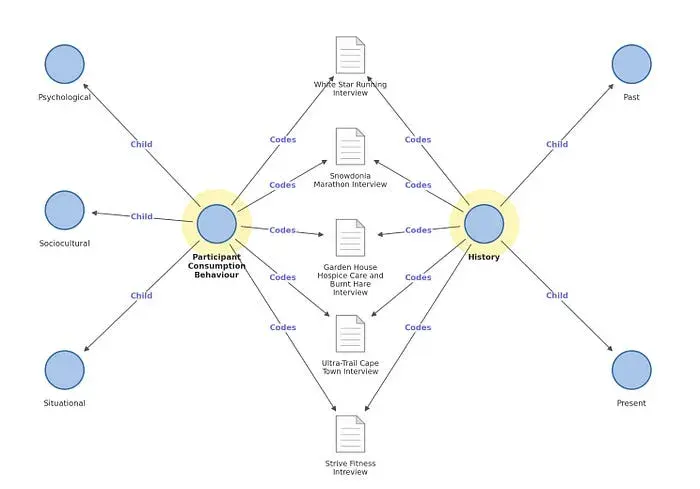
For the purpose of this study, the following demonstrates the coding system used to analyse these endurance events.
White Start Running: P01
Snowdonia Marathon: P02
Garden House Hospice Care and Burnt Hare: P03
Ultra-Trail Cape Town: P04
Strive Fitness: P05
Participant consumption behaviour
Before starting the analysis for participant consumption behaviour, a cluster analysis was created for the 20 most frequent words with synonyms were identified (shown in Figure 7). In order to create this analysis, the 5 interviews were used.

Psychological
From looking at Figure 7, keywords associated with the psychological theory outlined in the literature review are ‘tough’ and ‘challenge’ which can be linked to participants' personal goal. This is further demonstrated through P02 who said “a lot of people take part for the challenge” which is similar to P05 who believe “most of the people that entered… it was because we had put it as a physical and mental challenge”.
Sociocultural
Sociocultural elements are heavily represented in Figure 7 as ‘people’, ‘friends’, ‘individuals’, and ‘community’ are all within the top 20 most frequently occurring words. This suggests that endurance events find sociocultural factors to be important for influencing participation to engage with their event. This was demonstrated through the semi-structured interviews as P04 said how “word of mouth is so powerful” which was emphasised further through P01 who said that WoM “is very important” to them.
When speaking about the response received to their events, P05 indicated “that was mostly through word of mouth” which was similar to the response given by P03 who said, “it has grown and obviously from word of mouth”. Something worth noting is the mention of the uncertainty surrounding WoM which P01 says “it is not something you can manage”. This compares to the response given from P04 who although found that WoM “can work against you”, they also state how they have found WoM to be “particularly strong in getting the message out there”.
Situational
Location was frequently mentioned to be an important factor for organisations when speaking about their events. Figure 11 demonstrates ‘place’ and ‘local’ to be commonly occurring words within this analysis. P04 made a relevant comment in that “there is a drive involved if they want to do something like that it isn’t just on your doorstep… that is a big attraction for some people”. Local events seem to be a recurring theme as P03 also noted how participants “don’t have to travel far” as well as P05 who said an attraction is that participants think “we haven’t got to travel far for it”.
The development of marketing communications
Another cluster analysis was created for the 20 most frequent words with synonyms was identified for the history of marketing communications as shown in Figure 8. This was composed from the 5 interviews conducted with endurance event organisers.

Past
P01 originally “started on Facebook in 2012” when they set up showing that they have always been using digital marketing. This is replicated by P04 who “traditionally [we] relied quite heavily on social media”. A core focus for the original use of this method was attracting participants, as P01 noted how “Facebook pages don’t give you the massive spread that they used to” which did not have as much of an immediate demand as P02 found that “10 years ago… as long as you had them within a day or two that’s great”.
Present
Figure 8 shows that one of the key words used was ‘engagement,’ which demonstrates the line of communication between the endurance event and participant. This is demonstrated as the word frequency from the present history node includes ‘Facebook’, ‘email,’ and ‘social media’. This is supported by P03 how state that their marketing communications is “through social media [and] some things are through email” which is similar to the response given from P01 who stated that “social media is 75% of our marketing spread”.
Although digital communication is heavily represented, the use of traditional marketing communications was noted, such as P03, who said, “some people still like the traditional… even though social media is becoming bigger”. This is shown through P04, who “could promote the event across traditional platforms such as radio and newspaper”.
Discussion
The discussion of this study intends to look at the comparison of results given to analyse why participants engage in endurance events, and how this affects marketing communications. A primary area that will be looked at is how the participant consumption behaviour has influenced marketing communications. Four categories are looked at to explain the findings from this study which have been concluded through identifying recurring themes within this research.
Intrinsic motivation
It can be identified through looking at the current study, the importance of intrinsic motivation for endurance event participants. At the initial stages of this research, the application of Masters et al. (1993) was introduced for the purpose of analysing what motivates participants of endurance events specific to this study. Whilst Deci (1972) stated that people take part because they want to, relating to the concept of intrinsic motivation, Masters et al. (1993) created a study focused around both intrinsic and extrinsic motivation which was applied throughout this study.
When conducting the online surveys surrounding this theory, the majority of participants stated that they are intrinsically motivated. This was demonstrated through the option of ‘personal goal’ (34% voted for this) or ‘health orientation (13% voted) which were both highly rated intrinsic options. Compared to the extrinsic motivation categories, the highest individual rating was for ‘competition’ (11% voted) and ‘recognition’ (4% voted). Having seen a 23% difference in these statistics, it is evident that the participants of endurance events are intrinsically motivated.
Similarly, within the semi-structured interviews, a key word noted in the cluster analysis was ‘challenge’, which when applied to this theory is associated with participants personal goals. For this reason, the association had between participants is mirrored through the event organisers opinion, indicating that participants are intrinsically motivated.
Applying this analysis to the study, a key finding on why participants engage in endurance events has been illustrated. Although participants are seen to be intrinsically motivated to engage in endurance events, this still has an effect on the marketing communications. Masters et al. (1993) supported this view by stating that marketing communications need to be focused on what motivates the participant which includes both intrinsic and extrinsic factors.
Through the research conducted, it is clear that endurance event organisers have already become aware of this shift in participant motivation. Results showed how these events are already surrounding their marketing communications around the theory of intrinsic motivation (such as personal challenge). For this reason, it is evident that endurance events are aware of their participant and are actively targeting them through their marketing communications.
Word of Mouth
WoM was introduced as part of the socialising agents outlined by Mowen (1993) which was found to be one of the primary drivers behind purchasing decisions (Bughin et al., 2010). This importance found in the previous literature can also be seen throughout the research conducted in the online survey. Results show socialising agents to be the most important influencing factor with 26% of participants stating they were encouraged to sign up because of someone they know. This outweighed the results of ‘event website’ and ‘social media’ indicating the marketing communications surrounding voluntary and promoted methods to outweigh the managed methods (Fill and Turnbull, 2016). These results are supported by the semi-structured interviews where P05 states that “it was mostly through word of mouth” whilst speaking about the response received to their event.
The cluster analysis performed for the semi-structure interview demonstrates that 20% of the most frequent words surrounded socialising agents. P01 and P04 both state that WoM is ‘powerful’ and ‘very important’ for their endurance event. However, they also comment on how WoM “it is not something you can manage” as it “can work against you”. This demonstrates that although endurance event organisers are aware of the importance of WoM, they do not yet create ‘promoted’ marketing communications to encourage it further.
Through this analysis, it is clear the importance WoM creates for endurance events. At the moment, these organisations view WoM as a tool that appears without any direction from their part. However, after conducting this study, it can be seen that WoM is something that endurance events are able to control and should be actively trying to control. A large proportion of why participants engage in endurance events is due to the effects of WoM. This effect has yet to be utilised by the organisations within their marketing communications, which is necessary if they want to expand their reach.
Digital marketing communications
The development of marketing communications has been outlined through research surrounding Objective 2. It implies that the modern application of marketing communications surrounds the concept of an open line of communication compared to the traditional one-way approach. Through the semi-structured interviews, it became apparent that although organisations did not mention specifically how, they were creating an open line of communication. This was demonstrated through the cluster analysis presenting ‘Facebook’, ‘email’ and ‘social media’ as frequently used words. As earlier identified, the communication model surrounds digital communication which supports the findings from the semi-structured interview. For this reason, it indicates that endurance events are engaging in the modern approach of digital marketing communications.
This is similar to the results seen earlier in Figure 6 demonstrating that when asked ‘what encouraged you to sign up’, 55% of responses related to a form of digital marketing communication (e.g. social media, online advertising, event website, and online blog). Having collected this data, it suggests that participants are interacting with marketing communications that have an open line of communication more than traditional marketing methods.
For the purpose of this study, it indicates that organisations are adapting to the changes in marketing communications. This ensures that they are moving away from the traditional approach of having core values surrounding feelings and emotions, and then targeting the modern approach of behaviour being the essential element. Having looked into the perspective of the participant and comparing this to the literature reviewed, it is visible that digital marketing communications is one of the main factors for engaging participants in endurance events.
However, whilst this is also having an effect on the way endurance events are positioning their marketing communications, these organisations need to include a clear approach to their open line of communication. As mentioned, this open line of communication was not mentioned within the interviews conducted. This suggests that endurance events need to begin putting more emphasis on engaging with their participants through their digital marketing communications, rather than trying to market their event through a one-way stream.
Application of the participant consumption behaviour model
The participant consumption behaviour model was introduced as part of Objective 1 to analyse why participants engage in endurance events. Whilst three categories make up this model (psychological, sociocultural, and situational), research looked at states that not all elements are needed. An example of this refers back to Shank and Lyberger (2015) who found situational elements to be temporary, therefore indicating it to be of lower importance compared to the other two categories.
Whilst this was found, other research stated that all three components of the participant consumption behaviour model are needed to explain why participants engage in endurance events (Engel et al., 1969).
Similarly, the development of marketing communications has found that consumer behaviour should be the focus (Fill and Turnbull, 2016). For this reason, for the behaviour of the participant to be included within marketing communications, the entire model needs to be utilised. Section 4 of this study had a large emphasis on this model and the research behind it, this indicated that participants of endurance events feel that all elements of the participant consumption behaviour model is essential for their decision to take part in the endurance event. This is shown through both the online survey and semi-structured interview, as they both express the importance of the three elements.
What this section of the study has been able to emphasise is that participants have a range of reasons why they engage in endurance events. Whilst this creates a complex understanding as to how to effectively target participants through marketing communications, it has illustrated that endurance events need to be creating more in-depth studies into their participants and targeting them accordingly. This forms the need for more research into this subject to allow for specific organisations to create a personalised marketing communications plan.
Summary of research findings
Returning to the question set at the beginning of this research project, this study set out to explore why participants engage in endurance events, and how this affects marketing communications. It focused on participants in 2020 using half-marathons, marathons, and ultra-marathons as an example.
Through key findings within relevant literature and the data collected, this study has examined the factors which contribute to answering the research question set. This study has identified the reasons why participants engage in endurance events. Originally, this was found through literature and theories from publications from 1943 through to 2018. Accurate research was then conducted through an online survey and semi-structured interview to ensure the literature reviewed was relevant to the 2020 specification.
This study has shown that participants engage in endurance events through their own intrinsic motivation. Although this may render marketing communications ineffective, what has been shown is that the application of the participant consumption behaviour model needs complete consideration from the endurance event to build upon their marketing communications. Marketing communications is not hindered by the results of this study, instead, findings have been presented to demonstrate that engagement reasons from participants are not yet being utilised by these endurance events.
References
Andersen, J.J. (2020) The state of running 2019. Available at: https://runrepeat.com/state-of-running (Accessed: 23 February 2020).
Arndt, J. (1967) ‘Role of product-related conversations in the diffusion of a new product’, Journal of Marketing Research, 4(August), pp. 291–295.
Ballantyne, D. (2004) ‘Dialogue and its role in the development of relationship specific knowledge’, Journal of Business and Industrial Marketing, 19(2), pp. 114–123.
Belk, R.W. (1975) ‘Situational variables and consumer behaviour’, Journal of Consumer Research, 2(3), pp. 157–164.
Belk, R.W. (1976) ‘Situational mediation and consumer behaviour: a reply’, Journal of Consumer Research, 3(3), pp. 175–177.
Belk, R.W. (1979) ‘A free response approach to developing product-specific consumption situation taxonomies’, in Shocker, A.D. (ed.) Analytic Approach to Product and Market Planning. Cambridge, MA: Marketing Science Institute.
Bughin, J., Doogan, J., and Vetvik, O.J. (2010) ‘A new way to measure word-of-mouth marketing’, McKinsey Quarterly, Issue 2.
Chirila, D., and Chirila, M. (2016) ‘The necessity of marketing in individual sports overview’, Agricultural Management, 18(2), pp. 51–54.
Connor, R.F., Altman, D.G., and Jackson, C. (1984) ‘A brave new world for evaluation’, in Connor, R.F., Altman, D.G., and Jackson, C. (ed.) Evaluation Studies Review Annual. Beverly Hills, CA: Sage.
Corbae, G., Jensen, J., and Schneider, D. (2003) Marketing 2.0. Berlin: Springer-Verlag Berlin.
Curtis, J., and McTeer, W. (1981) ‘The motivation for running’, Canadian Runner, pp. 18–19.
Doyle, P. (2000) ‘Value based marketing’, Journal of Strategic Marketing, 8, pp. 299–311.
Drucker, P. (2006) Management: Tasks, responsibilities, practices. New York, NY: Harper and Row.
Engel, J.F., Kollat, D.T., and Blackwell, R.D. (1969) ‘Personality measures and market segmentation’, Business Horizons, 12(June), pp. 61–70.
Fill, C. (2011) Essentials of marketing communications. Harlow: Pearson Education Limited.
Fill, C., and Turnbull, S. (2016) Marketing communications: discovery, creation and conversations. 7th edn. Harlow: Pearson Education Limited.
Fink, A. (2013) How to conduct surveys. 5th edn. Thousand Oaks, CA: Sage.
Garcia-Haro, M., Canas, R.M., and Martinez-Ruiz, M.P. (2015) ‘Value co-creation, social media, and marketing 3.0: towards the search for competitive advantages in firms’, Integrating Social Media into Strategic Marketing, pp. 99–119.
Garden House Hospice Care and Burnt Hare (2020) Telephone conversation with Garden House Hospice Care and Burnt Hare, 16 April.
Greene, J.C., Caracelli, V.J., and Graham, W.F. (1989) ‘Toward a conceptual framework for mixed-method evaluation designs’, Educational Evaluation and Policy Analysis, 11, pp. 255–274.
Gronroos, C. (2004) ‘The relationship marketing process: communication, interaction, dialogue, value’, Journal of Business and Industrial Marketing, 19(2), pp. 99–113.
Hanneman, R., Kposowa, A.J., and Riddle, M. (2013) Basic statistics for social research. San Francisco, CA: Jossey-Bass.
Hesse-Biber, S. N. (2017) The practice of qualitative research. 3rd edn. Thousand Oaks, CA: Sage.
James, W. (1890) The principles of psychology. New York: Henry Holt & Company.
Kang, B. (2014) Factors affecting knowledge-sharing within endurance-sports online communities. Doctor of Philosophy PhD thesis. Auckland University of Technology. Available at: https://core.ac.uk/download/pdf/56364636.pdf (Accessed: 19 February 2020).
Kotler, P., and Armstrong, G. (2017) Principles of marketing. 17th edn. Harlow: Pearson Education Limited.
Kotler, P., and Keller, K. (2012) Marketing management. 14th edn. New Jersey: Prentice Hall.
Loewenstein, G. (1999) ‘Because it is there: the challenge of mountaineering… for utility theory’, Kyklos, 52(3), pp. 315–344.
Masters, K. S., Ogles, B. M., and Jolton, J. A. (1993) ‘The development of an instrument to measure motivation for marathon running: the motivations of marathoners scales (MOMS)’, Research Quarterly for Exercise and Sport, 64, pp. 134–143.
Masters, K.S., and Lambert, M.J. (1989) ‘The relations between cognitive coping strategies, reasons for running, injury, and performance of marathon runners’, Journal of Sport and Exercise Psychology, 11, pp. 161–170.
McCarthy, E.J. (1960) Basic marketing: a managerial approach. Homewood: R.D. Irwin.
McDonald, M., Milne, G., and Hong, J. (2002) ‘Motivational factors for evaluating sport spectator and participant markets’, Sports Marketing Quarterly, 11, pp. 100–113.
Mowen, J. (1993) Consumer behaviour. 3rd edn. New York: Macmillan.
Ng, J., and Lonsdale, C. (2010) ‘Motivation and psychological preparation for marathons’, in Fong, B., and Wai, H.O. (ed.) Marathon in Hong Kong. Hong Kong: The Chinese University of Hong Kong Press.
Parker, R., and Funkhouser, G.R. (1997) ‘The consumer as an active member of the channel: implications for relationship marketing’, Journal of Marketing Theory and Practice, 5(2), pp. 72–79.
Ray, M.L. (1973) ‘A decision sequence analysis of developments in marketing communication’, Journal of Marketing, 37(1), pp. 29–38.
Reuter, B. (2012) Developing endurance. Chanpaign: Human Kinetics.
Saunders, M., Lewis, P., and Thornhill, A. (2016) Research methods for students. 7th edn. Harlow: Pearson Education Limited.
Seo, W. J., and Green, B. C. (2008) ‘Development of the motivation scale for sport online consumption’, Journal of Sport Management, 22(1), pp. 82–109.
Shank, M.D., and Lyberger, M.R. (2015) Sports marketing: a strategic perceptive. 5th edn. New York: Routledge.
Shilbury, D., Westerbeek, H., Quick, S., Funk, D. and Karg, A. (2014) Strategic sport marketing. 4th edn. Crows Nest: Allen & Unwin.
Sieber, S.D. (1973) ‘The integration of field work and survey methods’, American Journal of Sociology, 78, pp. 1335–1359.
Snowdonia Marathon (2020) Telephone conversation with Snowdonia Marathon, 14 April.
Strive Fitness (2020) Telephone conversation with Strive Fitness, 24 April.
Todorova, G. (2015) ‘Marketing communication mix’, Trakia Journal of Sciences, 13(1), pp. 368–374.
Ultra-Trail Cape Town (2020) Telephone conversation with Ultra-Trail Cape Town, 24 April.
Vallerand, R.J., and Rousseau, F. L. (2001) ‘Intrinsic and extrinsic motivation in sport and exercise: a review using the hierarchical model of intrinsic and extrinsic motivation’, in Singer, R.N., Hausenblas,
H.A., and Janelle, C.M. (ed.) Handbook of sport psychology. New York: John Wiley and Sons, Inc.
Warren, M. (2020) Word of mouth marketing in 2020: how to create a strategy for social media buzz and skyrocket referral sales. Available at: https://www.bigcommerce.co.uk/blog/word-of-mouth-marketing/#why-care-about-word-of-mouth-marketing (Accessed: 23 April 2020).
White Star Running (2020) Telephone conversation with White Star Running, 9 April.
White, B., and Rayner, S. (2014) Dissertation skills for business and management students. 2nd edn. Hampshire: Cengage Learning EMEA.
Wood, J.T. (2009) Communication in our lives. 4th edn. Belmont, CA: Thomson-Wadsworth.
Zhang, J., Bennett, G., and Henson, R. K. (2003) ‘Generation Y’s perceptions of the action sports industry segment’, Journal of Sports Management, 17(2), pp. 95–115.


Comments