How has the male gaze impacted the perspective of women in sports marketing?

This is a study I completed in 2021. I have removed sections of this report for the purpose of online publication.
“… If you show your skin, you’re easy, and you’re a sl*t, and you’re a wh*re… Let’s turn it around and be empowered in that. Showing your body and showing your skin — or not — should not take any respect away from you,” stated Eilish during a 2021 Vogue interview (Snapes, 2021, p. 154). Thus, it is important to recognise the gradual movement being taken towards female empowerment. While this is the case, objectification surrounding women in sports marketing has constantly applied that their ‘sex appeal’ is more important than their athletic ability (Fink, 2013, p. 335). Research surrounding this topic began to populate during the late 1900s, showing how women are being objectified within sports marketing campaigns (e.g., Blinde et al., 1993; Messner, 1988; Theberge, 1987).
Throughout this period, research on objectification stemmed from the concept of the ‘male gaze’, which was established by Mulvey (1972), outlining women as “the bearer of meaning and not the maker of meaning…” This term indicates that women are put into view to be observed from an objectified heterosexual viewpoint, rather than maintaining control over their thoughts. Despite this, during the early 2000s, research began to surface on women empowering themselves through the sports industry (e.g., Carty, 2005; Daniels, 2012; Schwartz, 2018). For this reason, the central theme of this research concerns the topic of turning objectification into empowerment and how the male gaze has impacted the perspective of women in sports marketing.
Previously, research concluded that women in sports marketing campaigns have been objectified through the application of the male gaze theory, which portrays the perspective of the male opinion (Carty, 2005, p. 137; Knight and Giuliano, 2001, p. 224). For this research, ‘objectification’ will be summarised by the term provided by Bartky (1990) as something which occurs “whenever a woman’s body (is)… regarded as if they were capable of representing her”. This compares to the second term used within this study, ‘empowerment’, which is about people gaining control over their life by accessing power over the areas that they once lacked (Perkins and Zimmerman, 1995).
More recent studies have outlined the progression towards women's empowerment within the sports industry (e.g., Drake, 2017; Marshall et al., 2018), however, research has yet to investigate how the ‘male gaze’ has implicated the empowerment of women in sports marketing. For this reason, this research paper sets out to explore how the recent feminist movement, also referred to as fourth- generation feminism (Keohane, 1986), has allowed women in sports marketing to feel empowered rather than objectified.
This research will surround early studies, such as Young (1980, p.155), who outlines that woman portray their body as a ‘mere thing’, showing evidence of how the ‘male gaze’ has controlled the media’s attention of women in sports marketing. From this, the research will aim to explore the connection between objectification and empowerment to explore the relevance of both concepts within modern day. By the end of this study, it aims to discover research that encourages women to take part in sport and overcome the barrier of body image set by the marketing industry and the male gaze.
Based on the findings of Drake (2017) and Marshall et al. (2018), whereby they identify the growth in female empowerment, it is important to further demonstrate the shift from objectification to empowerment within sports marketing. By conducting this research, it will allow women to see the change in sports marketing, thereby creating less stigma surrounding women participating in sport. This is essential to further research as Engender (2016) states that 75% of women wanted to become active but found that body image was a barrier to this endeavour. Due to this, it can be summarised that earlier research conducted by Young (1980) and Daniels (2012) is still relevant as they outline that women in sports are considered as objects in the media.
The study seeks to address the following research objectives:
Develop an understanding of how objectification and empowerment are incorporated into the sports marketing industry within modern-day society.
Investigate the influence of fourth-wave feminism on the boundaries set by the male gaze.
Determine the relationship between the public, and women in the sports industry, to see the relation of women empowerment.
Objectification and empowerment within sport marketing
Since the 1900s, objectification has been mentioned in studies when researching how women are portrayed in the media. As previously outlined, this study will use the definition of objectification given by Bartky (1990) as something which occurs “whenever a woman’s body (is)… regarded as if they were capable of representing her”. A study made by Daniels (2012, p.80), stated how ‘it is not unusual’ for female athletes to be objectified when they are in the marketing industry. This same study details how the concepts surrounding objectification occur when males see a woman’s body for the purpose of pleasure, which indicates how women are portrayed as a ‘mere thing’ within the media (Young, 1980, p. 155).
Whilst this concept is from the perspective of a dated source, this is further supported by a recent study by Kessel (2018), who stated that if a sport is not sexualised, it will not perform well. This outlines the continuous objectification that women in the sports industry are subjected to.
Over the past two decades, studies surrounding women in sport have been noticeably increasing to indicate that women are gaining spotlight within the marketing industry (Flink, 1998, p. 40; Carty, 2005, p. 132). Despite this, Flink (2013, p. 331) outlines how women in sport marketing are still under-represented. While this is the case, Kane (2011) found that the media is suppressing interest in women’s sport by objectifying their sporting accomplishments. Based on the ideas from Antil, Burton and Robinson (2012, p. 302) it is suggested that when women are objectified, the athlete is seen in a negative way, leading to less interest in them. This correlates with how a wide majority of research has outlined the struggles women athletes face regarding objectification. This suggests that’s whilst there is an increase in interest surrounding women’s sport, the sexualisation that the media subjects’ athletes to is stopping the incline. The connection between these points can be seen to have a negative effect on female athletes being used as endorsers of sexualisation.
More recent studies have begun to investigate how women are now empowering themselves within the industry. Carty (2005, p. 137) investigated how women are portrayed as ‘strong and powerful’ through the way the media projects them. Complementary to this, research has been conducted on how women can empower themselves by being both strong and sexy. For this reason, whilst sexualisation has become a term associated with objectification, it shows that objectification is subjective to the athletes’ opinion (Hucal, 2019; Schwartz, 2018; Hayes, 2016).
Hayes (2016) stated that “if someone interprets something as sexy that’s not meant to be then you can’t obviously control that, but I think it’s an area we can continue to grow in in sport”. As explained by Perkins and Zimmerman (1995), empowerment is about people gaining control over their life by accessing power over the areas that they once lacked. Whilst objectification can be linked to the physical portrayal of the women’s body, women are now finding empowerment from sexualising themselves (Horan, 2016, p. 4). Arguably this indicates that women over time have gained control over their body and now have the power, which can be seen as a modern form of self-empowerment.
This contrasts with the results shown at the end of Horan’s (2016) study whereby people believed that empowerment displayed in the form of sexualisation are a deep-rooted form of both objectification and empowerment. To identify how objectification and empowerment are incorporated into the sports marketing industry, it would be necessary to further research how different audiences react to these concepts. If these theories outlined can be applied to further studies, a modern representation of the views surrounding objectification and empowerment can be properly explored.
Male gaze in the time of fourth-wave feminism
Within the 1970s, Laura Mulvey originally created the concept ‘Male Gaze’ to describe how Hollywood films portray women from the point of view of a heterosexual male to be positioned as objects of desire (Mulvey, 1972). This term has been applied to marketing throughout the years to demonstrate how women are positioned within marketing to appeal to a male point of view (Young, 1980, p. 155; Fink, 2013, p. 335). Mulvey has since outlined that the concept of the male gaze can only be appropriately applied in the period that it was released (the 1970s). Given the information outlined in section 2.1. it can be concluded that the thoughts surrounding objectification once stemmed from men. However, this can now be thought as outdated in line with the analysis made by Mulvey. This means that the male gaze is no longer closely associated with objectification, and instead a new audience controls the objectification of women in sports marketing.
Another essential point shows that due to fourth-wave feminism, the male gaze has also become dated (Godoy-Pressland, 2015, p. 18). Munro (2013, p. 23) believes that the growth of the internet has helped fourth-wave feminism to become established as people are becoming less sexist and misogynistic in the public eye. This thought is replicated by Phillips and Cree (2014, p. 939) whereby they state that social media has helped to produce wider feminist movements and the way that women are communicated within the media. This is due to women learning to take control of their ‘womanhood’ as told by Looft (2017, p. 894), due to the constraints of earlier waves of feminism having different focal points that did not allow for the concentration of empowerment to surface.
In contrast to this is Horan’s (2016) study, which outlined that empowerment is another form of objectification if it is sexualised. This is seen further in a study from Carty (2005, p. 138), whereby it is identified that whilst the woman’s body may be perceived as objectifying as it meets the needs of the male gaze, it is about the way that a woman can claim her body and have freedom in her own power. For this reason, whilst Looft (2017) and Carty (2005) support the research surrounding the rise of fourth-wave feminism, Horan (2016) suggests that objectification is still at the forefront of the movement. This demonstrates a need for further understanding surrounding the connection of the public and women in the sports industry to conclude how fourth-wave feminism impacts objectification.
The connection of the public and women in the sports industry
Throughout this research, three key concepts have been outlined: objectification, empowerment, and the male gaze. These terms are all established around the perspectives of the public eye. To properly understand how the male gaze has impacted the perspective of women in sport marketing, the relationship between the public, and the women in the sports industry needs to be outlined. This has stemmed from how women throughout time have been projected as having a different status within the sports industry compared to men (Fink, 2013, p. 334). From this, stereotypes projected on women in the sports industry can be seen as they are outlined to be not as naturally strong or powerful asmen (Fink, 2012, p. 51).
Within the #GirlGaze study developed by Looft (2017), the concepts developed by Mulvey (1970) surrounding the male gaze are outweighed by the girl gaze. This looks at how the objectification of women should be looked at from the perspective of women rather than the perspective of men. This connects to how past research has looked at how the public have viewed the athlete rather than how the athlete has viewed themselves. For this reason, it is important to identify sources that acknowledge both the public and the athlete to determine where objectification stems from.
A study was conducted in 2019 by Hucal whereby it was discussed that woman were shown as strong and sexy in photoshoots done by Ellen Von Unwerth. Photos taken as part of this series were set out without any conception of objectification or the male perspective. Alongside this, Ellen Von Unwerth speaks about how “women want to be seductive” which needs to be accompanied by the respect of others (Alexander, 2018). This suggests that whilst the photos taken by Ellen Von Unwerth are sexualised, they are not supposed to be objectifying. For this reason, the public can be seen as the cause of the objectification of women within the media rather than those being photographed wanting to be objectified.
An example of the perspective being from the athlete is in a 1999 campaign created by sporting giants, Nike, whereby they had a female athlete pose nude expect from her shoes. The athlete states that she did it to showcase her strength rather than act as an object in the media (Carty, 2005, pp. 137- 138). Taking this study by Carty (2005) and the study developed by Hucal (2019), it demonstrates that despite over a ten-year publication difference, women are aiming for the same thing in marketing… empowerment. Despite this, both studies demonstrate the need for further investigation into the relationship between the public and women in sport marketing to show how the fourth-wave feminism has allowed for women to become empowered by their body rather than objectified.
How are women viewed in the sports world?
Throughout the results section, key findings and themes will be identified from the data collection methods outlined in the previous section. The results that have been obtained within the online survey are displayed in three categories to support the research objectives set at the start of this study. These themes include the influence of age, the influence of gender, and the perception of women in sports. Whilst the semi-structured interviews focus on the themes of, empowerment within sport, objectification within sport, and the future of women in sport. By categorising data into three key themes, it will allow for future comparison to be made between the two data sets within the mixed method approach.
The influence of gender
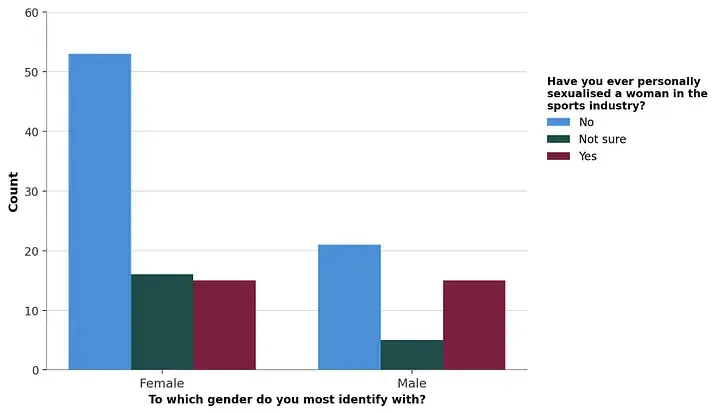
To outline the influence gender has on the objectification of women in sport, a range of crosstabulation diagrams will be used to show the results from the descriptive study. Figure 1 displays the influence gender has on if the participant has ever personally sexualised a woman in the sports industry. This concludes that whilst 63.1% of women state that they have not sexualised a woman in sport, 51.2% of men said the same. On the other end, 36.5% of men state that they have sexualised a woman in sport before, and only 17.8% of women said they have done the same.
This compares to Figure 2, which outlines those who have known someone else to sexualise a woman in the sports industry. Results show that 51.2% of women and 61% of men do know someone else to sexualise a woman in the sports industry. In both Figure 1 and Figure 2, this shows that more men are surrounded by objectifying topics about women in the sports industry.

To further look at the influence of gender, when asked how participants would describe a woman in the sports industry, ‘powerful’, ‘talented’, and ‘competitive’ got the most votes across both genders. In Figure 3, men ranked ‘talented’ as the most common description, compared to women who said ‘powerful’ best describes them. Three objectifying terms were put in this survey, ‘sexy’, ‘attractive’, and ‘beautiful’. 16.4% of men’s answers were one of these three terms which is similar to women, whereby 12.9% chose one of these terms.

The influence of age
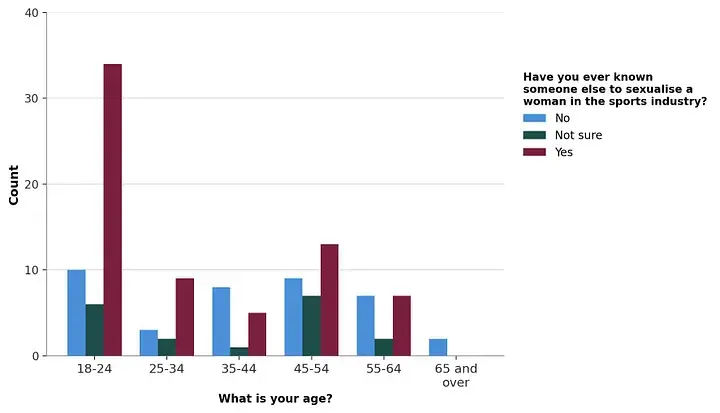
To allow for a coherent study, the same variants will be analysed regarding the influence of age. Figure 4 outlines the influence age has on if the participant has ever personally sexualised a woman in the sports industry. 32% of the 18–24 category state that they have whilst only 17.24% of the 45–54 category said they have sexualised a woman in sports before.

This compares to Figure 5, which outlines those that have known someone else to sexualise a woman in the sports industry. The largest age category from this study was 18–24, and from this group, 68% had said they know someone else that has sexualised a woman in the sports industry.
To see how this further progressed within the study, participants were ranked on their answers to how they would describe a woman in the sports industry. For the objectifying terms put in this survey, Figure 6 shows that ‘sexy’, ‘attractive’, and ‘beautiful’ were selected by 14.9% of the 18–24 category. This rating is similar to the 35–44 category who had 16.6% picking one of these terms, and the 55–64 who had 11.4%. The lowest-ranked group was the 45–54-year-olds, with 9.9% selecting this answer, compared to the 25–34-year-olds, who had a 10% difference of 19.2%.

The perception of women in sports
As earlier identified, most participants stated that they have never personally sexualised a woman in the sports industry before. Results shown in Figure 7 demonstrates that out of the three objectifying terms used within this study, 43.6% of those that stated that they had never objectified a woman in sport, used an objectifying term to describe them. This is similar to those that answered ‘not sure’ as they make up 20.8% of the responses.
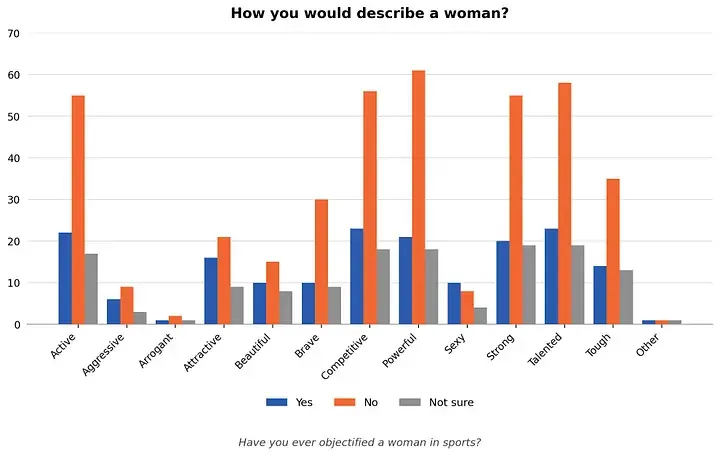
Figure 8 outlines a graph showing that the photos of Alex Morgan and Serena Williams in revealing outfits had the highest-ranking words of ‘attractive’, ‘beautiful’, and ‘sexy’, which are the three objectifying words. Serena Williams had 81% of votes for the term ‘sexy’ compared to Alex Morgan who had 77% for the term ‘attractive’. This compares to the second photos shown of Alex Morgan in her sports gear which had 97% for the term ‘active’, as well as Serena Williams playing tennis who had 96% for both ‘strong’ and ‘powerful’.

What do women in the sports industry think of this?
Interviews took place with five women from the sports industry. The aim was to obtain an understanding of how women have been objectified and empowered within their sport. From this, themes were curated to ensure that the objectives of this study were met, and thematic analysis could be applied. From this, the three main themes that were coded: objectification within sport, empowerment within sport, and the future of women in sports. From this, sub-themes were developed to enhance the understanding surrounding the main themes. The following outlines a coding system developed to categorise the participants' data. To protect participants' privacy, they are referred to by their sport.
Interview with Swimmer: P01
Interview with Triathlete: P02
Interview with Bodybuilder: P03
Interview with Olympic Weightlifter: P04
Interview with Archer: P05
Objectification within sport
Objectification was outlined by the participants by the way women are seen, with high emphasis being seen on the context of dehumanising a person. P01 referred to objectification as when women “are supposed to look pretty and do certain things”. P03 said it is “seeing women in a sexual way rather than (seeing them as) a person”. P04 said something similar and outlined it as “treating them to stereotypes rather than treating them as human”. Finally, P05 said that objectification is when “someone sees you as an item rather than something that is living”.
Only P02 considered the concept that men can also be objectified by stating “you can objectify men just as you objectify women… it is focusing on what their body looks like and what gratification people can get from that”.
Participants spoke heavily about objectification surrounding the clothing they were wearing. P02 said “I was wearing shorts and would get beeped at…. I guess there is that part of just being out in the world as a woman”. This is similar to P03 who spoke about wanting to wear shorts in the gym but not doing so because “obviously you don’t want people to stare”. P05 even summarised objectification by stating that “any sport can be objectified depending on what you wear”, showing a connection between clothing and objectification.
In relation to the male gaze, P01 spoke about training with men and summarised it by saying “they see you differently and you are a woman now and you are like a prospect now… it was like a mini competition within themselves… who is going to get the girl first”. On the other end of this topic, other participants spoke about how the issues surrounding objectification do not just stem from men. P03 outlines that “it doesn’t just happen from males” as well as P02 who summarised these ideas by stating “it is important that we realise that it is not just men it is not just how men perceive us but also how women perceive women”.
Empowerment within sport
Relating to the topic of empowerment within sport, participants summarised the concept by stating it is “supporting each other and not putting anyone down” as told by P04. This is similar to P02 who states, “empowerment is allowing people to be themselves and celebrate their achievements”. As well as this, P03 said empowerment is about “not caring what other people think doing whatever you want to do without anyone stopping you”. In summary of these quotes, P01 said empowerment is “lifting someone up and not giving them voice but making them believe that they already have one and letting them use that voice that they already have”.
When asked about if the environment they are in helps them feel empowered, P05 said “it is better to find a place where it feels like family” as well as P04 who said they are empowered by “the gyms that I go to and the people I surround myself with”. More depth from this question was found from P01 who spoke about how “it is really dependent with who you surround yourself with as I have had really supportive coaches and they were just brilliant for any sort of mishap or difficult time”.
The future of women in sports
All participants see the future of women in sports in a similar way, this was outlined by P02 who said “it is all of our responsibilities in how we call out our friends behaviour and it is being able to have those conversations without it being defensive and listening to a women if they say they have been objectified… it is acknowledging that it is society as a whole and it is not just men doing this”. This was supported by P01 who said, “I think if women routed for women, it would make it a lot easier for women to say no… so if all women supported women, we would be halfway there”.
On a similar topic, P05 said that the future of women’s sports should be “more women feeling comfortable to do the sport than feeling it is something that they can’t do”. This aligns with P01 who spoke about how “there are role models out there but there needs to be more of a platform for them to shout about it”.
Summary of research findings
At the beginning of this study, the research set out to explore turning objectification into empowerment, and how the male haze has impacted the perspective of women in sports marketing.
This study has outlined the change from objectification to empowerment through critically analysing studies from the 1900s through to recent studies conducted in 2019 to show a history of trends. Supporting research was then conducted using a mixed-methods approach made up of a descriptive study in the form of an online survey, as well as an exploratory study which was a semi-structured interview.
To outline the summary of the research objectives set within this study, a short summary for each objective has been provided.
Develop an understanding of how objectification and empowerment are incorporated into the sports marketing industry within modern day.
Findings from this study allowed further analysis to be made on the existing literature surrounding objectification and empowerment within the sports marketing industry. Results discovered that whilst some women use sexualisation to encourage empowerment, others still believe sexualisation links directly to the concept of objectification. For this reason, this objective was met through creating an understanding that whilst objectification is still present in modern day, empowerment is heavily beginning to outweigh the concept from the perspective of the female athlete. For this reason, it is important to connect this objective with the final objective to fully determine the relationship between the public and women in the sports industry to understand how to further reduce the objectification of women in sports marketing.
Investigate the influence of fourth-wave feminism on the boundaries set by the male gaze.
This objective was met through establishing how the male gaze is within the time of fourth-wave feminism within the literature and the primary research conducted in the online survey and semi- structured interview. Whilst the male gaze has been found to be a dated theory, this can be credited to the rise of fourth-wave feminism (Mulvey, 1972; Godoy Pressland, 2015). Research shows that due to both men and women having equal responsibility towards objectification, the male gaze is no longer the appropriate theory as this is directly solely at men. Despite this, research concluded that whilst the male-gaze is no longer applicable, the concepts surrounding the theory are. This suggests that further research is required to discover how a new audience objectifies women in sports marketing.
Determine the relationship between the public, and women in the sports industry, to see the relation of women empowerment.
The final objective has demonstrated the relationship between the public and women in the sports industry showing the reduction of objectification with sports marketing. Within the discussion section, a range of literature and primary data was analysed to establish that women within the sports marketing industry do not feel objectified by sexualisation within the media. However, this also illustrated how the public are still heavily objectifying the sexualisation of women in sports marketing demonstrating the need for future research surrounding how to reduce these concepts from the public.
References
Alexander, E. (2018). Ellen Von Unwerth talks selfies, sexual harassment and her ultimate muse. Retrieved 29 August 2021, from https://www.harpersbazaar.com/uk/fashion/fashion-news/a20159172/ellen-von-unwerth-interview/
Antil, J., Burton, R., and Robinson, M.J. (2012). Exploring the challenges facing female athletes as endorsers. Journal of Brand Strategy, 1(3), pp. 292–307. Retrieved from https://www.researchgate.net/publication/285992311
Bartky, S. L. (1990). Feminity and domination. Studies in the phenomelogy of oppression. New York. Routledge.
Blinde, E.M., Taub, D.E., and Han, L. (1993). Sport participation and women’s personal empowerment: Experiences of the college athlete. Journal of Sport and Social Issues, 17(1), pp. 47–60. Doi: 10.1177/019372359301700107
Carty, V. (2005). Textual portrayals of female athletes. A Journal of Women Studies, 26(2), pp. 132-172. Doi: 10.1353/fro.2005.0020
Daniels, E. (2012). Sexy versus strong: what girls and women think of female athletes. Journal of Applied Developmental Psychology, 33(2), pp. 79–90. Doi: 10.1016/j.appdev.2011.12.002
Drake, V. (2017). The impact of female empowerment in advertising (femvertising). Journal of Research in Marketing, 7(3), pp. 593–599. Doi: 10.17722/jorm.v7i3.199.g76
Engender. (2016). Sexism in advertising, what can we do? Retrieved 11 January, 2021, from, https://www.engender.org.uk/news/blog/sexism-in-advertising-what-can-we-do/
Fink, J.S. (2012). Homophobia and the marketing of female athletes and women’s sport. In G. B. Cunningham (Ed.), Sexual Orientation and Gender Identity in Sport (pp. 49–60). College Station, TX: Center for Sport Management Research and Education.
Fink, J.S. (2013). Female athletes, women’s sport, and the sport media commercial complex: have we really “come a long way, baby”?. Sport Management Review, 18(3), pp. 331–42. Doi: 10.1016/j.smr.2014.05.001
Flink, J.S. (1998). Female athletes and the media: strides and stalemates. Joperd, 69(6), pp. 37–45. Doi: 10.1080/07303084.1998.10605573
Godoy-Pressland, A. (2015). No hint of bulging muscles: The surveillance of sportswomen’s bodies in British media. Journalism, 17(6), pp. 744–759. Doi: 10.1177/1464884915583770
Hanneman, R., Kposowa, A.J., and Riddle, M. (2013). Basic statistics for social research. San Francisco, CA: Jossey-Bass.
Hayes, A. (2016). Ad industry needs ‘massive shift’ in mindset to stop sexualising female athletes, warns top star. Mumbrella. Retrieved 11 January, 2021, from https://mumbrella.com.au/sharni-layton-dont-make-female-athletes-sex-objects-ads-384885
Hesse-Biber, S. N. (2016). The practice of qualitative research. Sage.
Horan, A. L. (2016). Picture this! Objectification versus empowerment in women’s photos on social media (Honours Program Theses and Projects). Bridgewater State University, Massachusetts.
Hucal, S. (2019). Sex sells: the objectification of women in advertising. DW. Retrieved 11 January, 2021, from https://www.dw.com/en/sex-sells-the-objectification-of-women-in-advertising/a-47282358
Kane, M.J. (2011). Sex sells sex, not women’s sports. The Nation. Retrieved 12 January, 2021, from https://www.thenation.com/article/archive/sex-sells-sex-not-womens-sports/
Keohane, N.O. (1986). A Fourth Wave? The Wilson Quarterly, 10(5), pp. 154–158.
Kessel, A. (2018, March 26). From surfing to tennis, sportswomen still face sexualised media coverage. The Guardian. Retrieved 12 January, 2021, from https://www.theguardian.com/lifeandstyle/2018/mar/26/sportswomen-sexualised-media-coverage-surfing-tennis
Knight, J.L., and Giuliano, T. (2001). He’s a laker; she’s a “looker”: the consequences of gender-stereotypical portrayals of male and female athletes by the print media. Sex Roles, 45(3), pp. 217–229. Doi: 10.1023/A:1013553811620
Looft, R. (2017). #GirlGaze: Photography, fourth wave feminism, and social media advocacy. Journal of Media & Cultural Studies, 31(6), pp. 892–902. Doi: 10.1080/10304312.2017.1370539
Marshall, K., Chamberlain, K., and Hodgetts, D. (2018). Female bodybuilders on Instagram: negotiating an empowered femininity. Feminism and Psychology, 29(1), pp. 96–119. Doi: 10.1177/0959353518808319
Messner, M. (1988). Sports and male domination: the female athlete as contested ideological terrain. Sociology of Sport Journal, 5, pp. 197–211. Doi: 10.1123/SSJ.5.3.197
Mulvey, L. (1972). Visual pleasure and narrative cinema. In Durham, M.G., and Kellner, D.M. (Ed.), Media and cultural studies (pp. 267–274). John Wiley & Sons Ltd.
Munro, E. (2013). Feminism: A fourth wave? Political Insight, 4(2), pp. 22–25. Doi: 10.1111/2041-9066.12021
Nielsen Sports. (2018). Global interest in women’s sports is on the rise. Retrieved 11 January, 2021, from https://nielsensports.com/global-interest-womens-sports-rise/
Perkins, D. D., and Zimmerman, M. A. (1995). Empowerment theory, research, and application. American journal of community psychology, 23(5), pp. 569–579. Doi: 10.1007/BF02506982
Phillips, R., and Cree, V.E. (2014). What does the ‘Fourth Wave’ Mean for Teaching Feminism in Twenty-First Century Social Work? Social Work Education, 33(7), pp. 930–943. Doi: 10.1080/02615479.2014.885007
Saunders, M., Lewis, P., and Thornhill, A. (2016). Research methods for students (7th ed.). Harlow: Pearson Education Limited.
Schwartz, A. (2018). Sports illustrator’s spectacularly silly #metoo swimsuit issue. The New Yorker. Retrieved 12 January 2021, from https://www.newyorker.com/culture/annals-of-appearances/sports-illustrateds-spectacularly-silly-metoo-swimsuit-issue
Tashakkori, A., and Teddlie, C. (2010). Putting the human back in ‘‘human research methodology’’: The researcher in mixed methods research. Journal of Mixed Methods Research, 4(4), pp. 271–277. Doi: 10.1177/1558689810382532
Theberge, N. (1987). Sport and women’s empowerment. Women’s Studies International Forum, 10(4), pp. 387–393. Doi: 10.1016/0277–5395(87)90056–2
Young, I. (1980). Throwing like a girl: A phenomenology of feminine body comportment motility and spatiality. Human Studies, 3(2), pp. 137–156. Doi: 10.1007/BF02331805


Comments